Claude is the better choice for deep reasoning, writing, analysis, and agentic coding you drive turn by turn. jo is a personal AI agent built to act across your real life — it runs on your own Mac and a private per-user cloud machine, works overnight through your email, calendar, and messages, and keeps long-running personal and family projects moving without being re-prompted.
The verdict
jo vs Claude, in one line.
jo vs Claude, side by side.
Both run on frontier models — jo actually talks to Claude among them — but they're built for different jobs: one answers when you ask, the other acts while you sleep.
| Claude | jo | |
|---|---|---|
| Product type | AI chat and reasoning assistant you prompt | Personal AI agent that acts for you |
| Where it runs | Anthropic's cloud | Your Apple Silicon Mac + a private per-user cloud machine |
| Works overnight, unprompted | —responds when you start a chat | ✓Preps tomorrow before you wake |
| Reads your inbox, calendar & messages | ✓via connectors like Gmail and Google Workspace, when you ask | ✓Continuously, in the background |
| Where you talk to it | Web, macOS and Windows desktop, iOS and Android apps, Claude Code | macOS, Telegram, WhatsApp & email |
| Keeps long-running personal projects moving | —Projects organize chats, but you drive each session | ✓Nudges you before loose ends pile up |
| Trains on your conversations | ✓consumer plans only, user-controllable; Team, Enterprise and API excluded by default | —Zero-data-retention model endpoints |
| Built for households | —plans are per individual or per seat | ✓One plan covers you + 4 family members |
| Pricing | Free; Pro $20/mo ($17 annual); Max from $100/mo; Team $25/seat/mo; Enterprise custom | $39/mo — 7-day full trial, no credit card |
| Best for | thinking, writing, analysis, and agentic coding | Running your real life and projects on autopilot |
Last updated June 2026. Sources: Claude pricing (claude.com/pricing); Claude features (claude.com); Anthropic consumer terms and data policy (anthropic.com/news/updates-to-our-consumer-terms); jo (askjo.ai).
Where each one is strong.
Claude key strengths
- Frontier reasoning and writing: Claude's Opus, Sonnet, and Haiku 4.x models are among the strongest available for analysis, long-form writing, and careful step-by-step thinking.
- Agentic coding with Claude Code: Claude Code reads your codebase, edits across files, runs tests, and commits — a genuinely capable terminal-first coding agent.
- Artifacts and a big context window: It builds live previews of code and documents and handles up to a one-million-token context on its top models, so large inputs fit in one session.
- Broad tool and connector ecosystem: Through MCP and connectors it plugs into GitHub, Slack, Google Workspace, and thousands more services when you wire them up.
jo key strengths
- Runs on hardware you control: jo lives on your Apple Silicon Mac and a private per-user cloud machine — not a shared chat database.
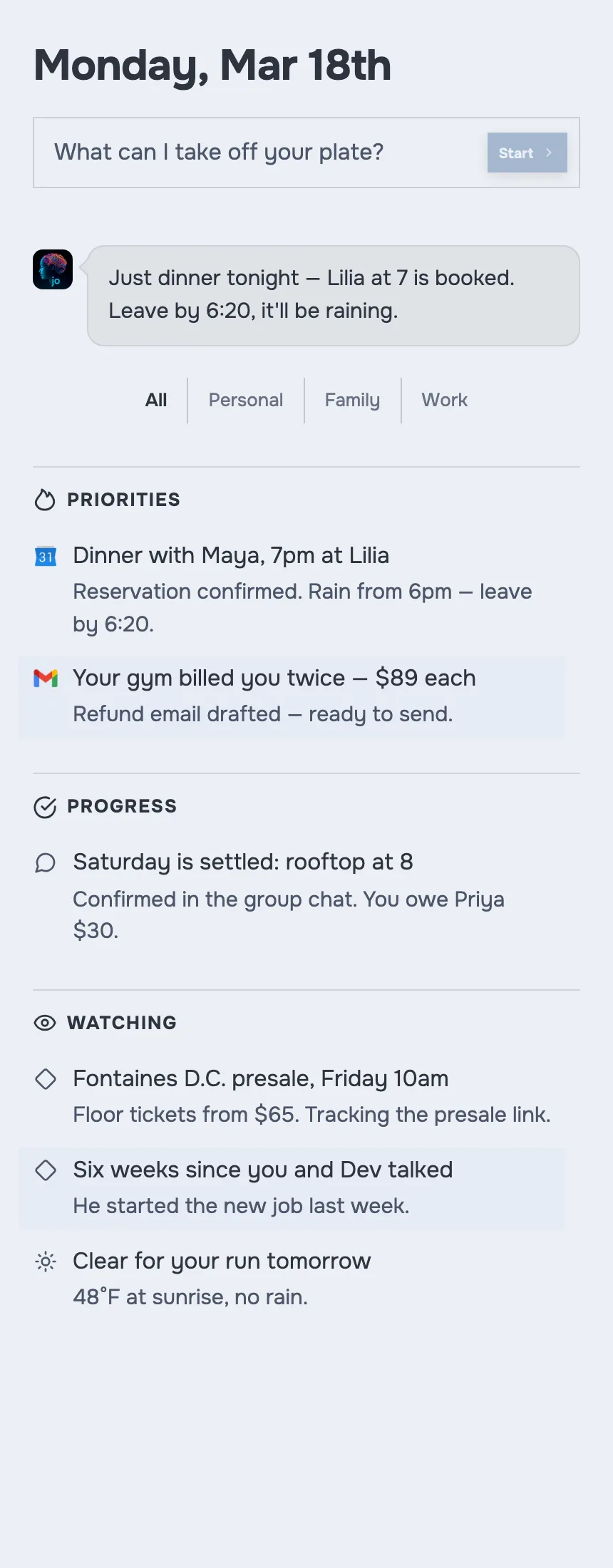
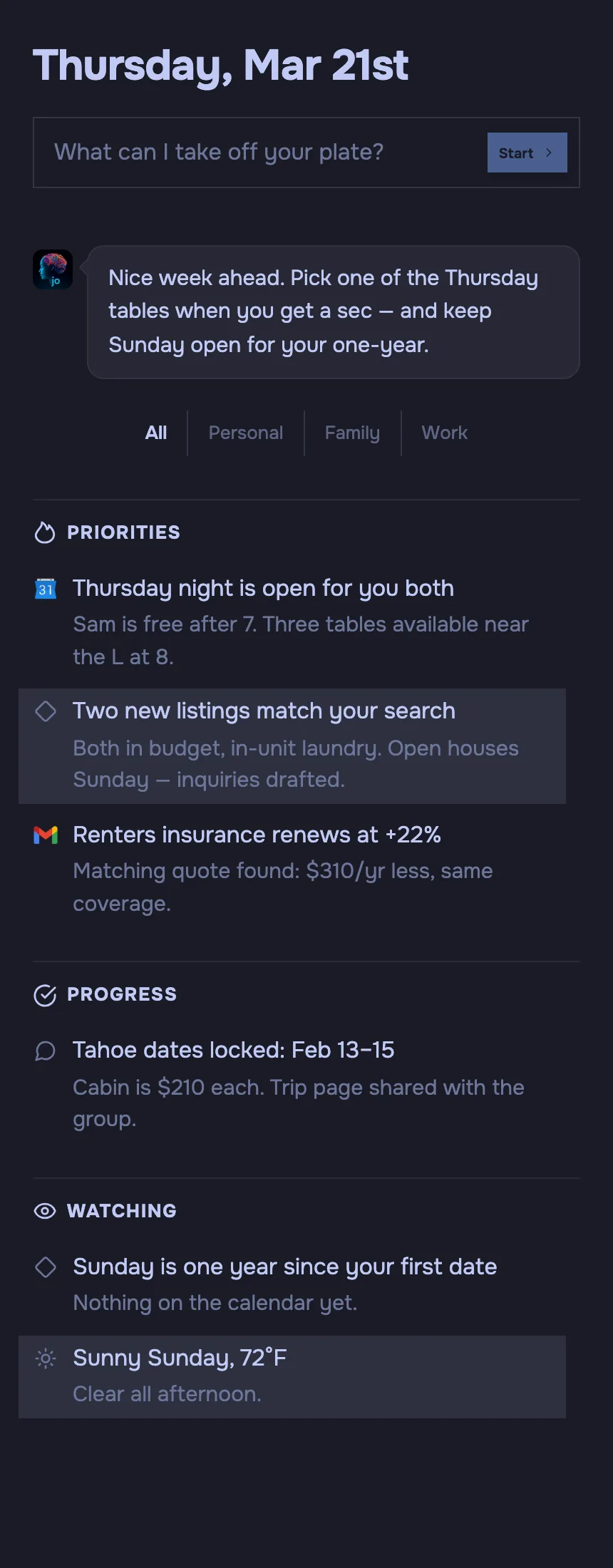
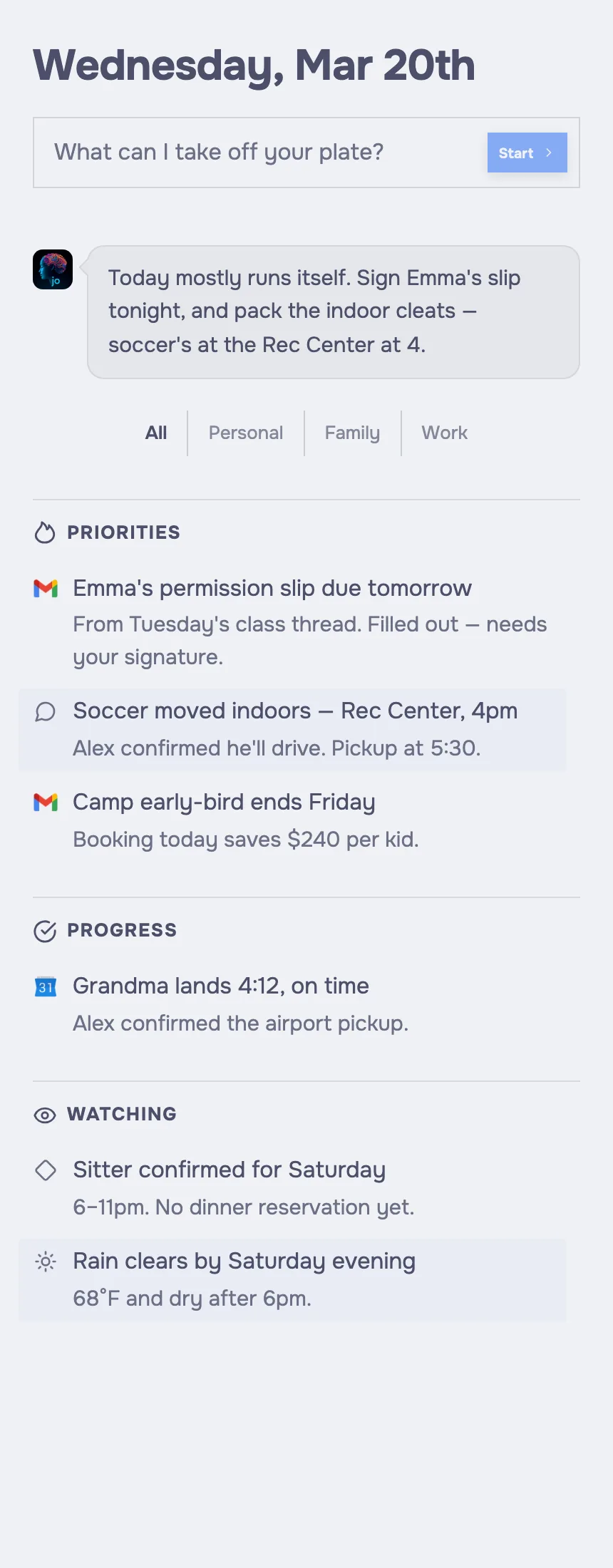
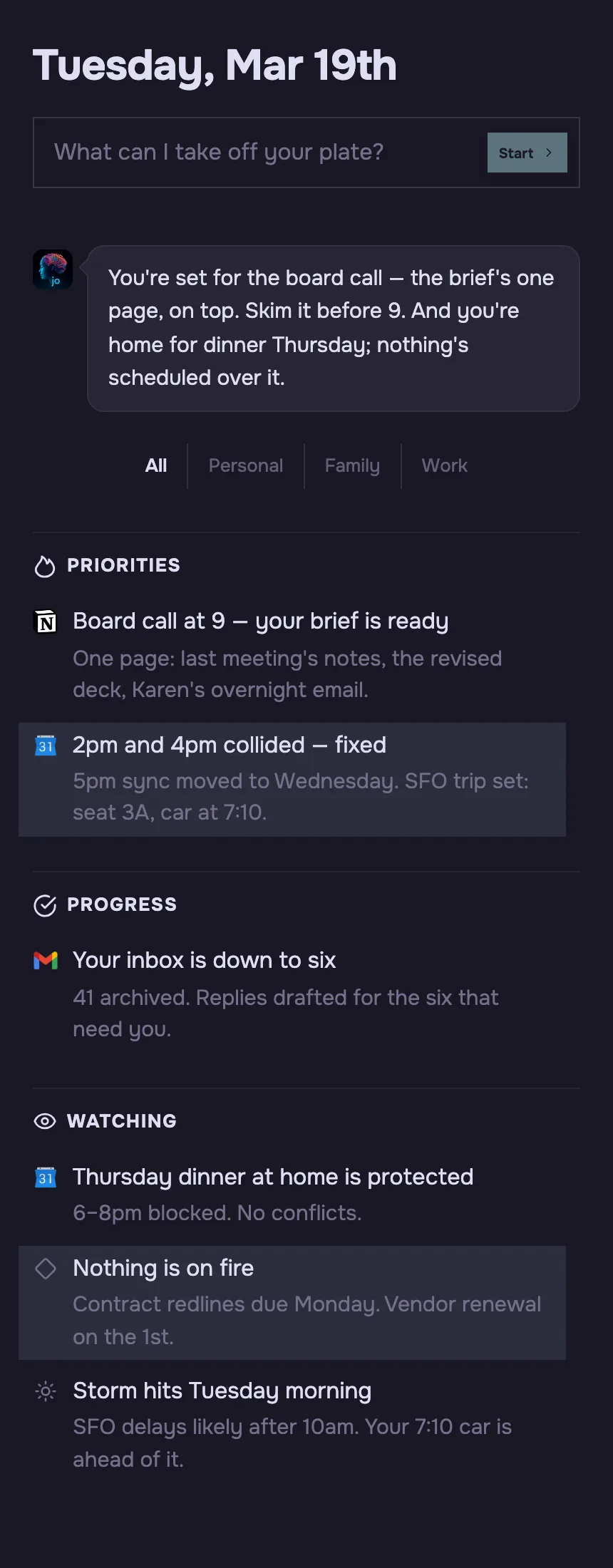
- Acts overnight, unprompted: jo watches the week and preps your day, so a morning brief is waiting before you ask for anything.
- Lives where you already talk: Reach jo from macOS, Telegram, WhatsApp, or email — the same memory and access in every channel.
- Private by default: jo uses zero-data-retention endpoints, so providers don't keep your prompts or train on your data.
- Keeps real projects moving: jo holds long-running personal and family threads warm and nudges you at the right moment.
- Built for the whole household: One $39/mo plan covers you plus four other family members.
What that means in practice.
Four places the jo and Claude experience diverge once you actually live with them.
Answering vs. acting
Claude is excellent the moment you ask it something — it reasons, writes, and codes on demand. jo is built to act without being asked: it reads your inbox and calendar overnight and has a brief ready before you wake. One waits for a prompt; the other works the gap between prompts.
A chat window vs. your own machine
Claude runs in Anthropic's cloud and you reach it through a chat. jo runs on your own Apple Silicon Mac plus a private cloud machine that's isolated to you, so raw messages and notes can stay on your hardware while jo still uses frontier models to think.
Sessions vs. long-running memory
Claude's Projects keep related chats together, but you steer each session. jo keeps long-running memory of your people, projects, and routines, then nudges you before loose ends pile up — it carries the thread across days, not just within a conversation.
One app vs. every channel
You talk to Claude in its web, desktop, and mobile apps. You reach jo on macOS, Telegram, WhatsApp, and email, with the same memory and access everywhere — so a reply you send from your phone lands with the same context as one from your Mac.
Which should you use?
Choose Claude if
- You want the strongest model for reasoning, writing, or analysis in a chat you drive yourself.
- You're coding and want a terminal-first agent like Claude Code that edits files, runs tests, and commits.
- You need one assistant you prompt on demand, not a background agent acting across your accounts.
- You want Artifacts, a very large context window, or a deep MCP and connector ecosystem to build on.
Choose jo if
- You want an agent that handles your day, not a window you have to open.
- You want email, calendar, and messages watched and prepped overnight.
- You want your data on your own Mac and a private machine, private by default.
- You want long-running personal and family projects kept moving.
- You want one assistant the whole household can use.
Questions, answered.
Is jo better than Claude?
Neither is strictly better — they do different jobs. Claude is a stronger pick for reasoning, writing, and coding you drive yourself. jo is better when you want an agent that acts across your inbox, calendar, and projects overnight, on your own Mac and a private cloud machine, without being re-prompted each time.
What is the difference between jo and Claude?
Claude is an AI assistant you prompt in a chat to think, write, and code. jo is a personal AI agent that runs on your own Mac and a private cloud machine, reads your email, calendar, and messages overnight, and keeps personal and family projects moving on its own — reaching you on macOS, Telegram, WhatsApp, and email.
Is jo cheaper than Claude?
They price differently. Claude is Free, Pro at $20/mo, Max from $100/mo, and Team at $25/seat/mo. jo is $39/mo after a 7-day trial, and one plan covers you plus four family members — five people total. For a household, jo's single plan often costs less than five separate Claude seats.
Can jo replace Claude?
For everyday acting on your real life — inbox, calendar, projects — jo does what a chat assistant can't. But jo isn't a replacement for sitting down to reason or code with Claude directly. In fact jo uses Claude as one of its underlying models, so you get Claude's thinking inside an agent that acts for you.
Does jo use Claude?
Yes. jo talks to frontier models — including Claude, plus ChatGPT, Gemini, Grok, and Kimi — through zero-data-retention endpoints, so providers don't keep your prompts or train on them. jo routes work to the right model for the task while keeping your raw data private to you.
Who should use Claude instead of jo?
Use Claude if you mainly want a powerful assistant to reason, write, analyze, or code in a chat you control turn by turn — especially for agentic coding with Claude Code. If you instead want an agent that quietly runs your inbox, calendar, and projects overnight, jo is built for that.
Start now.
Download jo, connect your apps, and get your first morning brief tomorrow.
No waitlist. No credit card required to start.
7 day full trial, then $39/mo for you plus 4 other family members.